Mold Removal in New Orleans, LA
You moved the bookcase and the wall behind it is freckled black. The plaster ceiling under the upstairs bath has a brown ring that keeps widening. The closet in the back of the double has smelled off since the storm. Call and describe what you’re seeing — we remove mold across New Orleans and Orleans Parish, and that is the whole job.
Where the job starts
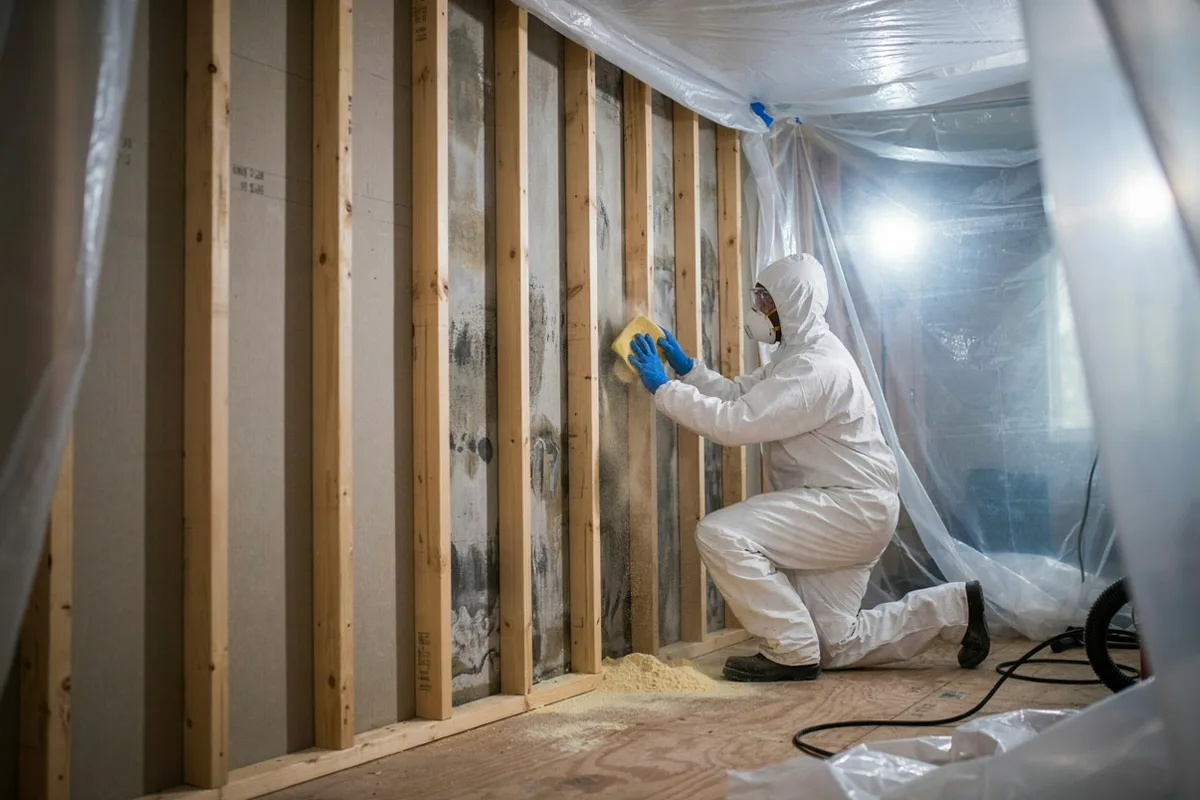
With the water. Moisture readings on the drywall, the plaster, and the framing set the edges of the work: which sheets come out, which studs get cleaned, and how far past the visible stain the wet area actually runs. That is the part of a mold job homeowners most often misjudge — the stain is the surface, and the boundary is usually wider than it looks. Then we seal the area in plastic, run it under negative pressure, and suit up.
What comes out, what stays
- Drywall, insulation, carpet pad, ceiling tile, and anything else porous that has been wet and moldy comes out, bagged inside the containment.
- Framing, brick, plaster lath, and slab stay and get cleaned in place, then HEPA-vacuumed and wiped down.
- Nothing is closed back up until the wood reads dry — LSU AgCenter puts the line below 20 percent moisture.
- Mold hides behind walls, under carpet, and around pipes, so what you see is often the edge of what’s there.
Tell Us What You See, 24/7
Why Moisture Comes First
Mold needs water, and if the leak that fed it is still running the removal won’t last. So part of every job is finding where the water came from and telling you what has to change before we close anything. EPA doesn’t recommend bleach as a routine practice and says not to paint or caulk over mold — a coat of paint changes the color, not the cause. Do the moisture work first.
New Orleans notes
Early-morning humidity here runs around 88 percent, so a wall cavity that got wet this week will not dry on its own. The old houses on piers carry plaster over lath, which cleans differently from drywall; the slab ranches in Lakeview and Gentilly were re-sheeted after the levee breaches and often carry a cut line that was closed a little too soon; the post-Katrina rebuilds are tight enough that a small leak has nowhere to go. We have worked in all three.
What you get when it’s done
A written report covering what we removed, from where, and why. Louisiana law requires it, and it’s the paper a buyer, a tenant, or an adjuster will want to see.